Arkansas roadways carry millions of drivers through intersections every day, many of which present far greater risk than their surroundings suggest. Crash investigations across the state consistently point to the same contributing factors: high traffic volume, driver distraction, poor sight lines, and inadequate signage converging at the same locations year after year. These are not random patterns. The most dangerous intersections in Arkansas share identifiable characteristics that data can reveal long before another collision occurs, and recognizing them is the first step toward making better decisions behind the wheel.
That knowledge becomes especially important when an accident does happen, and drivers find themselves navigating insurance claims, medical bills, and legal questions at one of the most stressful moments of their lives. Our team at Taylor King Law helps Arkansas drivers understand local crash risks and know where to turn when the road ahead gets complicated. Being On Your Side—By Your Side starts with making sure you have the information you need before and after a serious accident.
The most recent statewide safety analysis shows 605 roadway fatalities and 2,720 serious injuries in 2024, the latest figures available in the Arkansas Highway Safety Improvement Program (HSIP) 2025 Annual Report. These numbers represent only the most severe crash outcomes and do not capture the full volume of collisions that occur across Arkansas roadways each year.
The HSIP report also identifies intersections as one of the most consistently dangerous environments on the state’s roadways. Intersection crashes, intersection-related collisions, and crashes involving non-motorists collectively account for approximately 87 percent of roadway fatalities across the major crash categories analyzed.
That risk does not distribute evenly across the state. Urban areas generate the highest total collision counts due to traffic density and signalized intersections, while rural roadways tend to produce more severe outcomes because of higher travel speeds and longer emergency response times.
Across both environments, the same contributing factors appear repeatedly in crash investigations:
These patterns have remained largely consistent over time despite ongoing safety efforts across the state, as reflected in the statewide crash figures below:
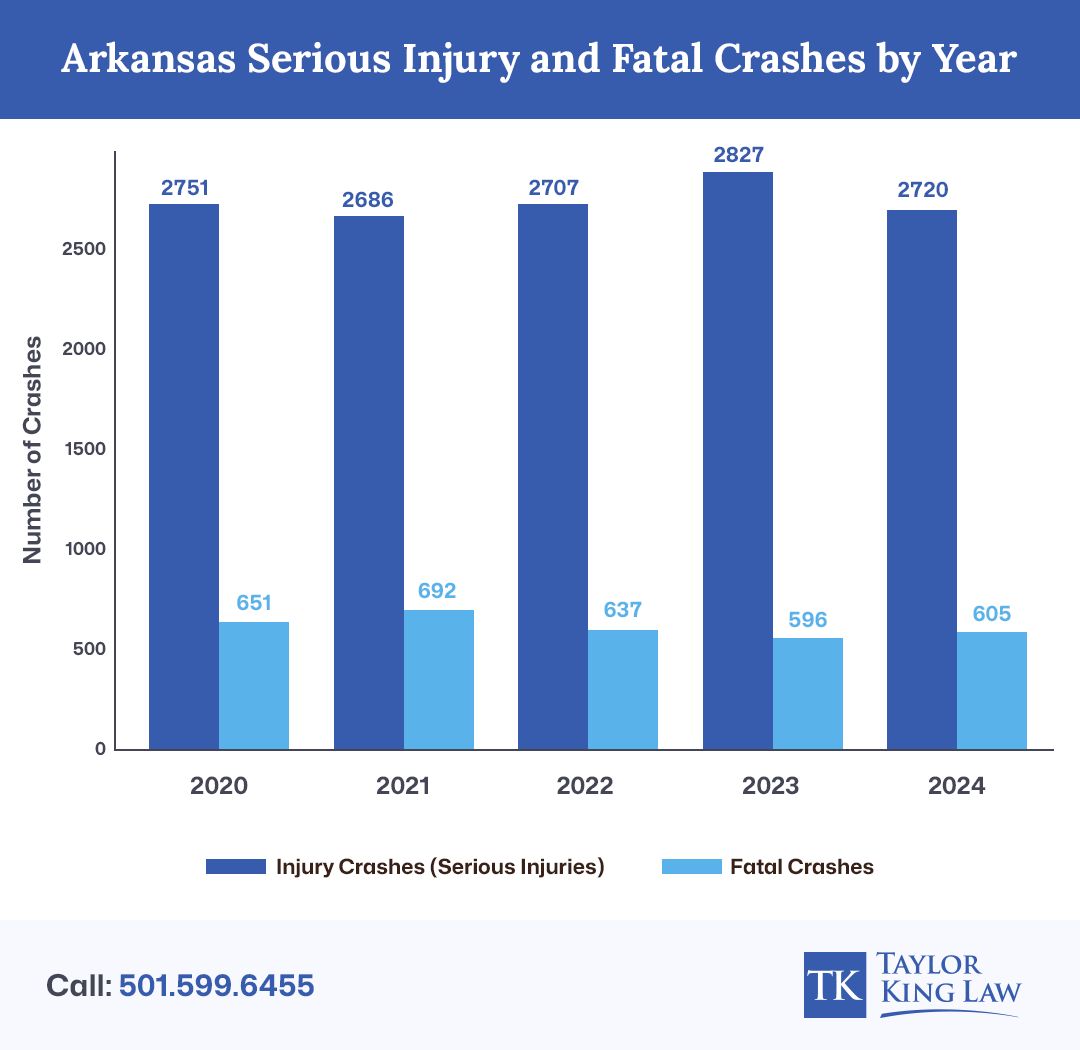
As population growth, expanding development, and increasing freight traffic continue placing additional pressure on Arkansas roadways, these numbers are unlikely to improve without a clearer understanding of where and why serious crashes occur. Transportation planners use this data to identify locations where signal timing upgrades, protected turn lanes, improved lighting, and redesigned traffic flow patterns could reduce serious outcomes for Arkansas drivers.
Understanding these patterns also matters for drivers and families navigating the aftermath of a serious collision, when knowing where liability concentrates and what factors contributed to a crash can make a meaningful difference in a personal injury claim.
Busy intersections create the highest risk for a serious car accident because drivers must react to traffic signals, turning vehicles, pedestrians, and multiple lanes of traffic at once. When congestion increases along major retail corridors or commuter routes, the number of potential conflict points between vehicles rises sharply. The most dangerous intersections in Arkansas share identifiable characteristics, including high traffic volume, frequent turning movements, and limited reaction time, that make them consistently more prone to serious collisions.
These conditions are not evenly distributed across the state; they tend to concentrate along major commercial corridors, interstate access points, and rapidly growing urban areas where traffic demand has outpaced roadway capacity.
The following intersections appear among the busiest and most collision-prone traffic corridors in Arkansas:
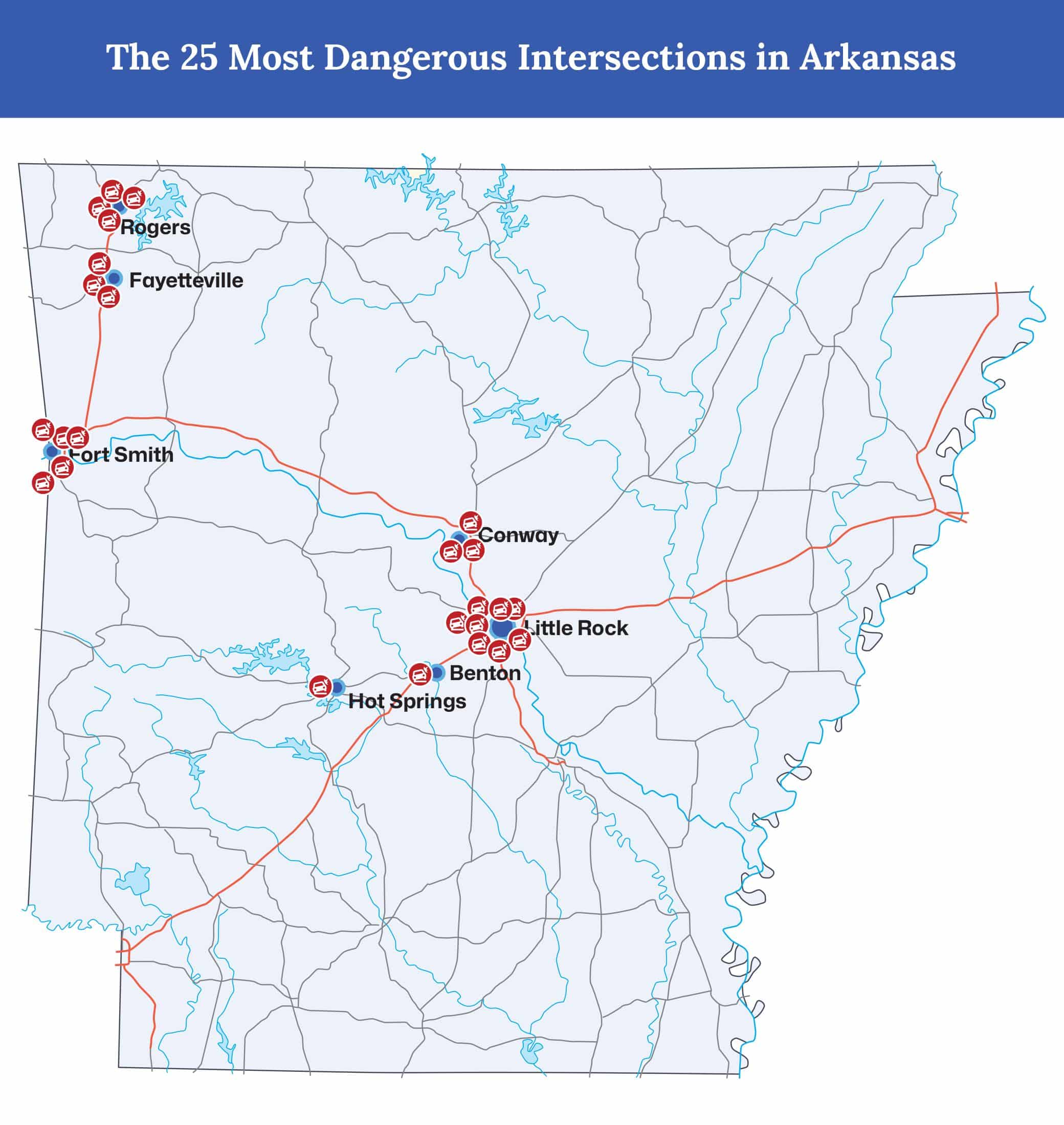
| Rank | Intersection | City | Common Crash Factors |
| 1 | Shackleford Rd & Markham St | Little Rock | Heavy retail traffic, multiple turning lanes |
| 2 | Rodney Parham Rd & Markham St | Little Rock | Retail entrances, signal congestion |
| 3 | University Ave & Markham St | Little Rock | High commuter traffic volume |
| 4 | Cantrell Rd & Mississippi St | Little Rock | High speeds, turning conflicts |
| 5 | Walton Blvd & Pleasant Grove Rd | Rogers | Retail congestion, interstate access |
| 6 | Joyce Blvd & College Ave | Fayetteville | University traffic, pedestrian crossings |
| 7 | Rogers Ave & Phoenix Ave | Fort Smith | Major commuter corridor |
| 8 | Central Ave & Higdon Ferry Rd | Hot Springs | Tourism traffic, congestion |
| 9 | Highland Dr & College Ave | Fayetteville | Campus traffic patterns |
| 10 | Dave Ward Dr & Broadway St | Conway | Rapid population growth, commuter traffic |
| 11 | Chenal Pkwy & Bowman Rd | Little Rock | Retail development, multiple lanes |
| 12 | Geyer Springs Rd & Baseline Rd | Little Rock | High traffic density |
| 13 | Rogers Ave & Towson Ave | Fort Smith | Freight and commuter traffic |
| 14 | Walton Blvd & New Hope Rd | Rogers | Retail corridor congestion |
| 15 | Cantrell Rd & Sam Peck Rd | Little Rock | Turning conflicts, heavy traffic |
| 16 | Markham St & University Ave | Little Rock | Dense urban commuter route |
| 17 | Phoenix Ave & Rogers Ave | Fort Smith | Signal congestion |
| 18 | Oak St & Joyce Blvd | Fayetteville | Retail access traffic |
| 19 | Dave Ward Dr & Salem Rd | Conway | Commuter congestion |
| 20 | Pleasant Grove Rd & Pinnacle Hills Pkwy | Rogers | Commercial development traffic |
| 21 | Highland Dr & Garland Ave | Fayetteville | Campus traffic |
| 22 | Chenal Pkwy & Rahling Rd | Little Rock | High traffic volume |
| 23 | Rogers Ave & Waldron Rd | Fort Smith | Turning conflicts |
| 24 | Airport Rd & Military Rd | Benton | Highway access traffic |
| 25 | Walnut St & Walton Blvd | Rogers | Retail congestion |
A closer look at the top ten reveals the specific traffic patterns, congestion factors, and driving conditions that make each one particularly dangerous. These are not isolated problem spots but locations where multiple risk factors consistently overlap, creating environments where serious collisions are far more likely than average:
Drivers traveling through these corridors should remain especially alert near signalized intersections, where sudden stops, turning vehicles, and lane changes frequently increase the risk of a serious car accident.
Contact Personal Injury Attorneys in Arkansas
The most dangerous intersections in Arkansas share more than a high crash count. Several common conditions explain why crashes occur at these locations with greater frequency than others:
When these conditions converge at the same location, the risk for drivers, passengers, and pedestrians rises significantly. For those injured at these intersections, understanding what contributed to the crash can make a meaningful difference in pursuing a claim.
Arkansas highways carry long-distance traffic, freight transportation, and commuter flow across large regions, creating conditions where crash risk extends far beyond city intersections. Individual crash reports published by the Arkansas Department of Public Safety reveal several corridors that appear with striking regularity, pointing to stretches of road where the combination of speed, volume, and road conditions makes serious accidents far more likely:
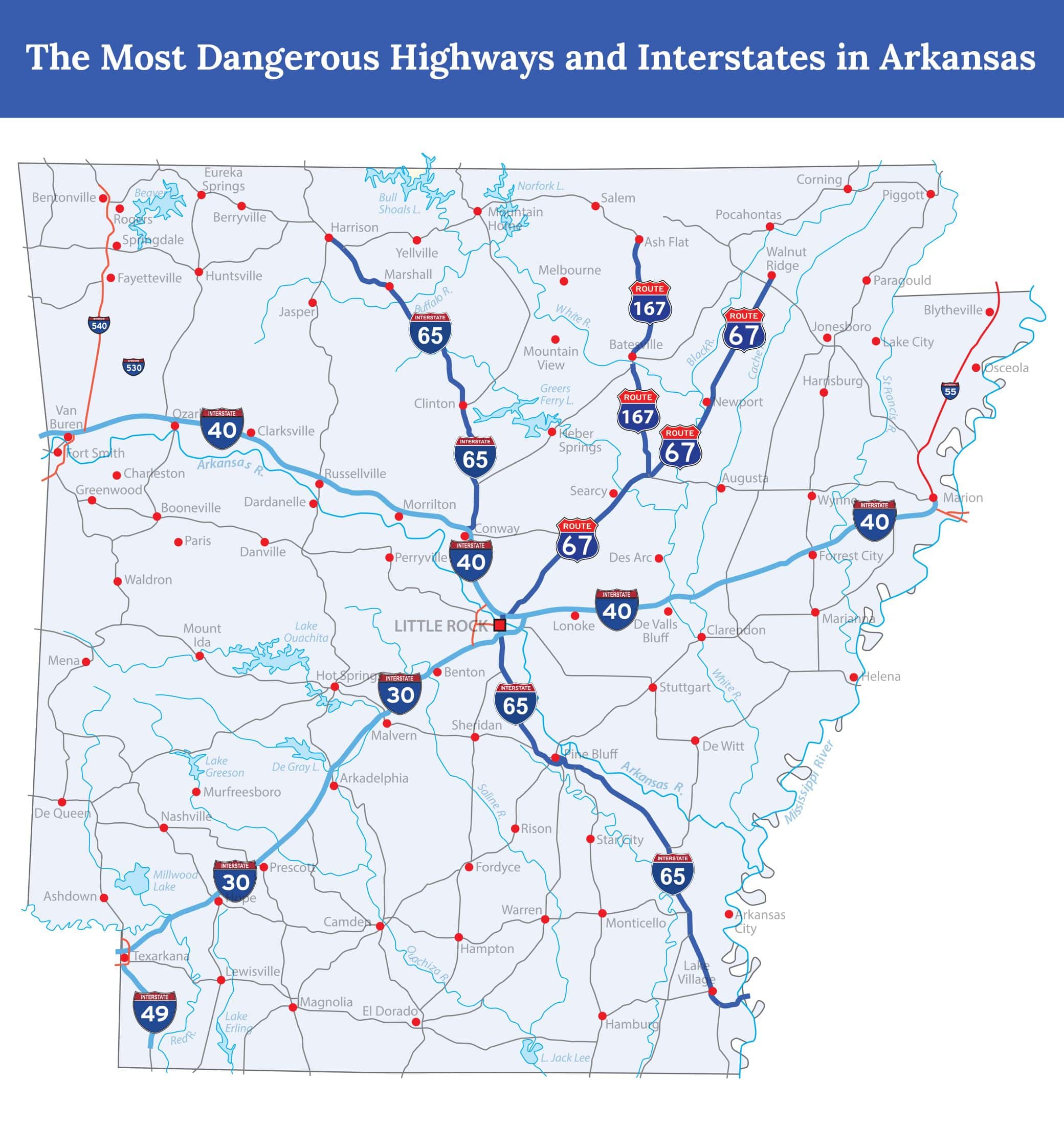
Drivers traveling these corridors should remain especially cautious, maintain safe following distances, and stay alert to sudden traffic slowdowns, changing weather, and heavy commercial truck activity.
When a serious collision occurs at a dangerous intersection or along a high-crash highway, access to trauma care can be the difference between recovery and lasting harm. The following trauma centers across Arkansas are equipped to handle severe injuries from car accidents:
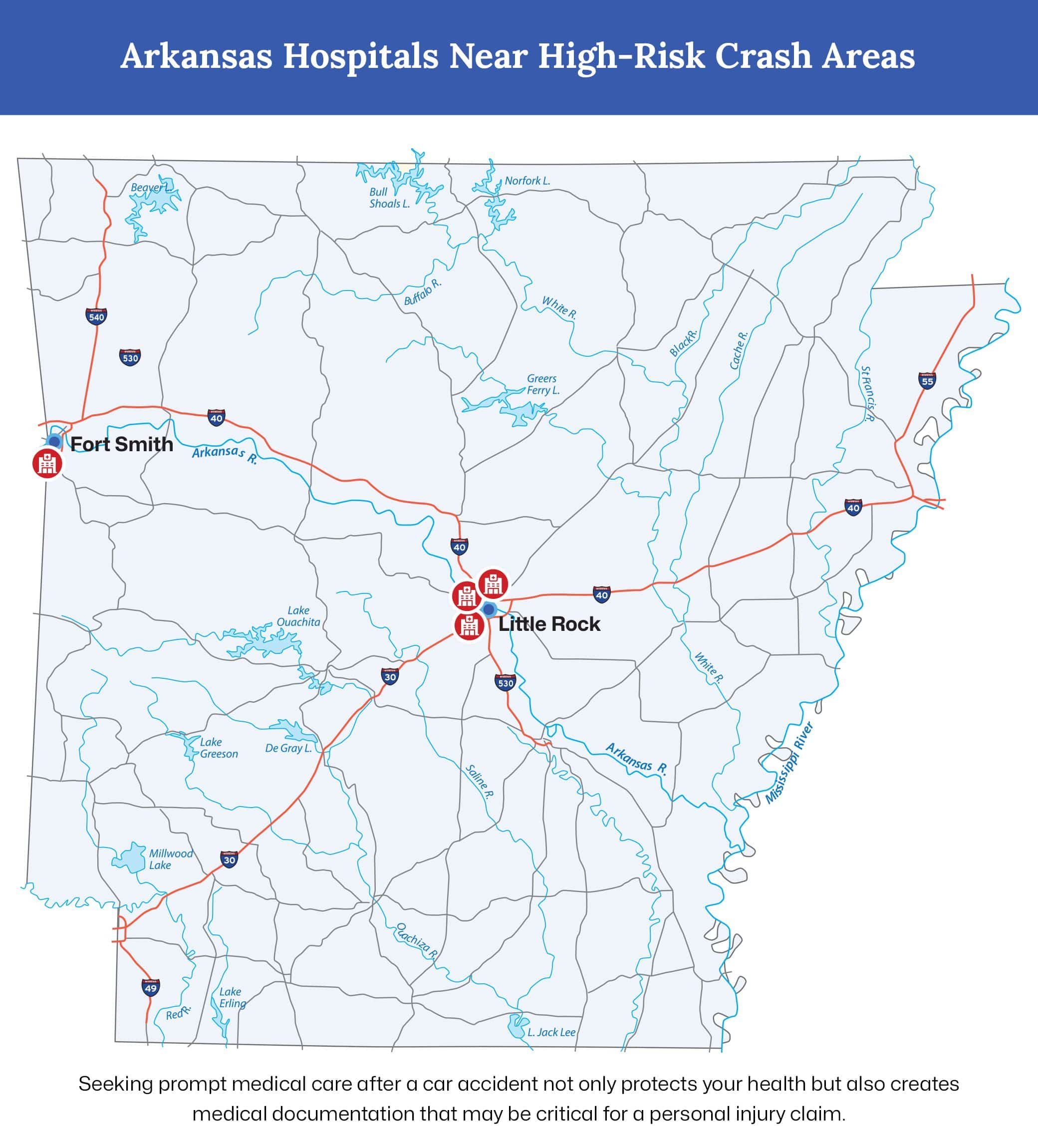
Seeking immediate medical care after a car accident does more than protect physical health; it creates documented medical records that connect injuries directly to the crash, which plays a critical role in supporting a personal injury claim.
Local law enforcement agencies investigate traffic collisions and produce the official crash reports required during insurance claims or personal injury lawsuits. The following agencies serve some of Arkansas’s highest-traffic corridors and can provide documentation critical to any accident claim:
If you were injured at any of these locations, obtaining the crash report quickly is one of the most important steps you can take to protect your claim. An experienced Arkansas car accident lawyer can help you secure that documentation and build a case around it from day one.
When a car accident claim cannot be resolved through insurance negotiations, civil litigation becomes the next step. In Arkansas, personal injury lawsuits typically proceed through state circuit courts in the county where the crash occurred or where one of the parties resides. The courts most commonly handling these cases include:
Once a lawsuit is filed, the process moves through several defined stages. The injured party files a complaint outlining their injuries, damages, and legal claims. The defendant responds, and both sides exchange evidence through discovery. Settlement negotiations frequently take place before the case ever reaches trial, though preparation for litigation often strengthens a claimant’s position at the negotiating table.
Filing deadlines matter in Arkansas. Under Arkansas Code § 16-56-105, injured individuals generally have three years from the date of the crash to file a personal injury lawsuit, though exceptions may exist depending on the circumstances surrounding the case. For those hurt at the most dangerous intersections in Arkansas, missing that deadline can permanently bar the right to pursue compensation, which is why contacting an Arkansas car accident lawyer early in the process is critical.
The moments following a car accident at one of the most dangerous intersections in Arkansas are critical. Decisions made in that window can shape both the outcome of a medical recovery and the strength of a future injury claim. Taking the right steps early helps protect both:
Evidence disappears, memories fade, and insurance companies move fast after an accident. Acting quickly and thoroughly matters even more in Arkansas, where comparative fault rules allow insurers to argue shared responsibility in order to reduce what an injured driver can recover. Solid documentation from the crash scene, combined with early legal guidance, gives injured drivers the strongest possible foundation for a claim.
When a crash at a dangerous intersection leaves you facing medical bills, missed work, and uncertainty about what comes next, having the right legal team makes a difference. At Taylor King Law, we are On Your Side—By Your Side through every step of the process. Our team investigates collision evidence, reviews police reports, and works to build the strongest possible case for injured drivers across Arkansas.
If you or someone you love was injured at one of the most dangerous intersections in Arkansas, call us today at 870-246-0505 for a free consultation and learn how our team can help your case.
Taylor King Taylor King opened the first office in 1994 and has been practicing law for more than 30 years. Those who know him best would describe him as “laser-focused,” which is good news for his clients and bad news for his golf opponents. Memberships & Professional History
Awards and accolades


This page has been written, edited, and reviewed by a team of legal writers following our comprehensive editorial guidelines. This page was approved by attorney Taylor King, who opened the firm’s first office in 1994 and has been practicing law for more than 30 years.
Please describe your accident and the injuries you sustained. One of our experienced injury lawyers will contact you for a free case evaluation. If we’re able to assist and you’re unable to travel, we can meet you at your home, workplace, or hospital.

call for a free consultation
820 W 3rd Street
Little Rock, AR 72201
Phone: 501.712.2554
Toll-Free: 1.877.455.4790
Fax: 870.246.0529
410 N Thompson Street, Suite B
Springdale, AR 72764
Phone: 479.935.1761
Toll-Free: 1.877.283.1274
Fax: 870.293.2475
320 Main Street
Arkadelphia, AR 71923
Phone: 870.246.0505
Toll-Free: 1.877.665.0873
Fax: 870.246.0529
2620 Prince Street
Conway, AR 72034
Phone: 501.712.2554
Toll-Free: 1.877.696.8695
Fax: 870.246.0529
1920 East Matthews Avenue
Jonesboro, AR 72401
Phone: 870.568.1158
Toll-Free: 1.877.589.2660
Fax: 870.520.5099
3801 Rogers Avenue
Fort Smith, AR 72903
Phone: 479.668.3198
Toll-Free: 1.877.899.3202
Fax: 479.234.4216
 call
call  message